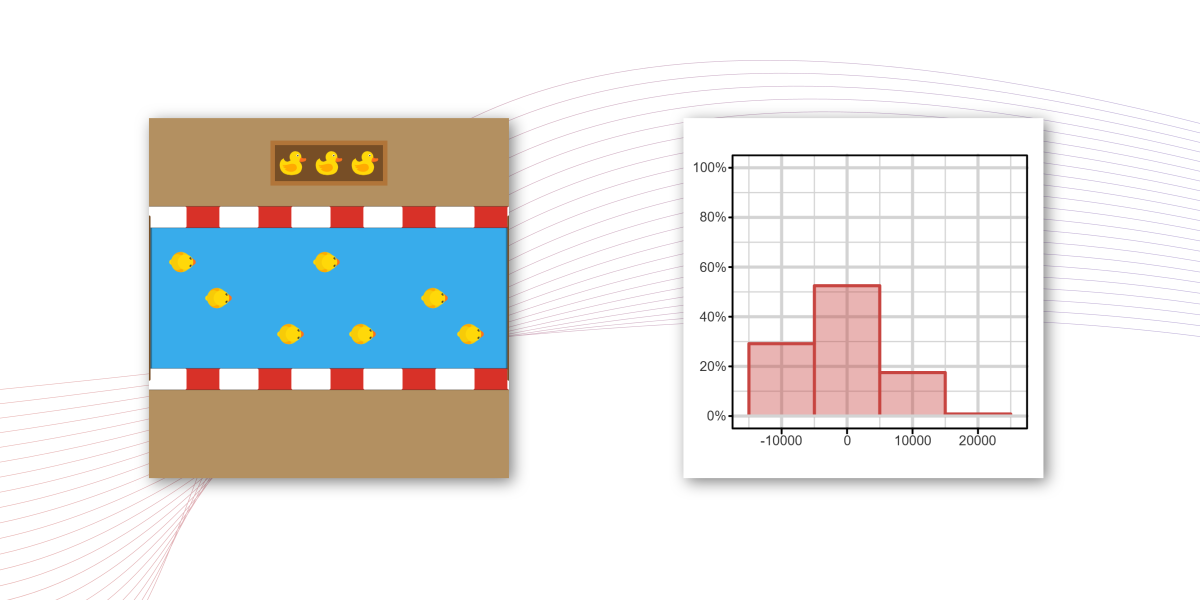
Let’s play a game! Here’s how it works. You pay $1.00 to choose three out of ten rubber ducks that continuously float along a waterway. Three of the ducks have a red mark on the bottom. For each red-marked duck you choose, you win $1.00.
Lucky Duck Game
Click three rubber ducks and see how much you win. Play the game several times to observe the pattern in your outcomes.
Note: The Simulation Results panel contains two charts that you can switch between. The Distribution chart shows the proportion of games that result in each net outcome. Your net outcome is the prize you win minus the cost of playing the game. The Mean Trend chart shows how the average net outcome changes as more games are played.
Ready for More?
This game was inspired by a set of problems in the Indonesian textbook Matematika untuk SMP/MTs Kelas IX [Mathematics for Grade 9] (p. 279). Below is an adapted English version of the original problems. Give them a try and use what you discovered while playing the game to support your reasoning.
Karuna runs a game booth at a funfair. The booth has a tub of water containing 10 rubber ducks. Three of the ducks have a red mark on the bottom. The rules of the game are as follows.
- Anyone who wants to play must pay $1.00.
- Karuna shuffles the positions of the rubber ducks in the tub and then invites the player to choose three ducks at the same time.
- For each red-marked duck selected, the player wins $1.00. For example, if a player selects two red-marked ducks, they receive a prize of $2.00.
With a game like this, can Karuna make a profit? Why? To answer this question, complete the following tasks.
- Determine the sample space for the game. Based on the sample space, decide whether Karuna makes a profit.
- Simulate the game for 50 players. Based on the simulation, does Karuna make a profit?
- Based on your findings, what advice would you give Karuna?